


After an accident, most people have the same basic concerns. They want to recover from their injuries, get their vehicle repaired, return to work, and understand how the insurance claim will be handled.
What many people do not realize is that some decisions made during this process can make a personal injury claim harder to resolve or reduce the compensation that may ultimately be available.
A delayed medical appointment, missing photographs, an incomplete account of the accident, or an early settlement accepted without understanding its terms can create problems later. Sometimes, the issue is not that an injured person did anything intentionally wrong. They simply did not know what information would matter.
For people dealing with an injury in Fort Worth, understanding these common mistakes can help them protect their health, keep better records, and make more informed decisions about an insurance claim.
It is important to remember that no single mistake automatically determines the value of every personal injury settlement. The outcome depends on the circumstances of the accident, the injuries, the available evidence, the applicable insurance coverage, and Texas law.
1. Delaying Medical Treatment After An Accident
One of the most common problems is waiting too long to get medical attention.
After a collision, adrenaline can make it difficult to recognize how badly you are hurt. Someone may feel shaken but otherwise fine, only to develop neck pain, back pain, headaches, or other symptoms later.
Another person may skip an appointment because they do not have time off work, cannot arrange transportation, or assume the pain will disappear.
The difficulty is that a delay can create two separate problems.
First, an untreated injury may become more difficult to manage. Second, an insurer may question whether the injury was caused by the accident, particularly if there is a significant gap between the collision and the first medical evaluation.
That does not mean a delayed appointment automatically invalidates a claim. There may be understandable reasons for the delay, and the medical evidence must be evaluated in context.
What to do instead: Seek appropriate medical attention, explain your symptoms honestly, and follow the treatment recommendations of your healthcare professional. If you could not obtain treatment immediately, keep a clear account of the circumstances and discuss them honestly with your medical provider.
Medical care should be based on your health needs, not on trying to create a particular insurance record.
2. Ignoring Medical Advice Or Missing Follow-Up Appointments
Seeing a doctor once may not be enough to address an injury.
Some conditions require follow-up appointments, physical therapy, additional testing, or a period of monitoring. If treatment stops unexpectedly, the insurance company may ask whether the injury improved, whether additional care was necessary, or whether something else caused the continuing symptoms.
Of course, people sometimes miss appointments for legitimate reasons. Work schedules, transportation problems, financial difficulties, and family responsibilities can all interfere with treatment.
The problem is not simply a missed appointment. It is the possibility that an incomplete medical record makes it harder to understand the injury and its effects.
What to do instead:
- Attend scheduled appointments when possible.
- Follow your healthcare professional’s recommendations.
- Tell your provider if treatment is not helping or symptoms change.
- Explain practical barriers to treatment so that alternatives may be discussed.
- Keep appointment records and relevant medical bills.
Do not continue a treatment you believe is unsafe or unnecessary just because you think an insurer expects it. Discuss your concerns with your healthcare professional.
3. Failing To Preserve Evidence From The Accident
A claim can become more difficult to evaluate when important evidence is missing.
Think about a collision at a Fort Worth intersection. The vehicles are moved, debris is cleared, and traffic returns to normal. A few days later, the drivers disagree about which vehicle entered the intersection first.
Photographs taken at the scene might have helped clarify vehicle positions, damage, traffic signals, or roadway conditions. Without them, the investigation may depend more heavily on witness accounts and other available evidence.
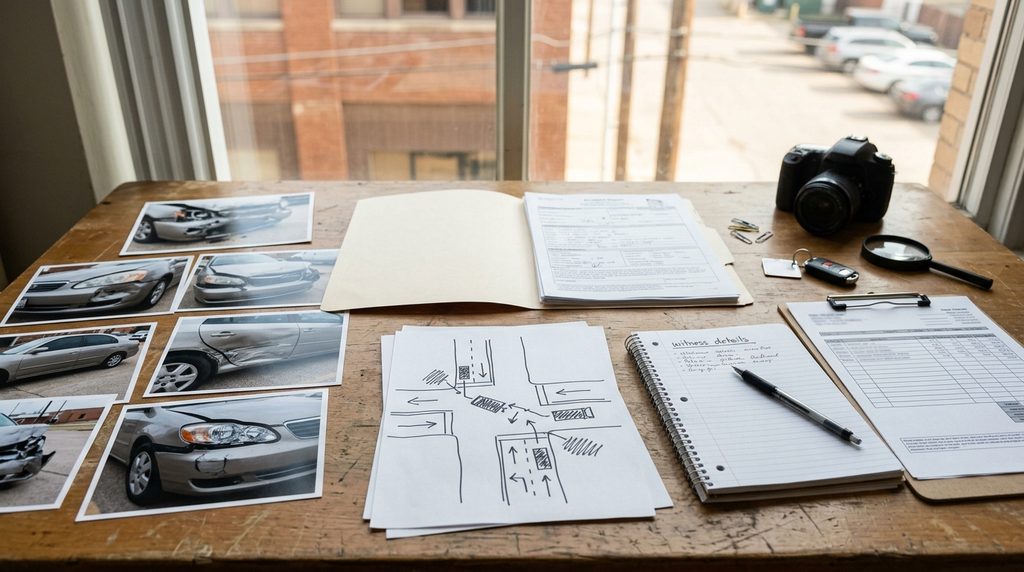
Useful evidence can include:
- Photographs of vehicle damage and the accident scene.
- Pictures of traffic signals, signs, and lane markings.
- Names and contact details of witnesses.
- The crash report number and relevant police records.
- Medical records and treatment documentation.
- Repair estimates and receipts.
- Available dashcam or surveillance footage.
The Texas Department of Insurance’s guide to what to do after a wreck recommends collecting driver information, photographing the vehicles and scene, speaking with witnesses, and keeping relevant records.
You do not need to put yourself in danger to gather evidence. If the roadway is unsafe, prioritize your safety and seek emergency assistance when needed.
4. Giving Inaccurate Or Incomplete Information
After an accident, an insurance adjuster may ask what happened, where the vehicles were positioned, or what injuries you experienced.
It is important to provide accurate information. Guessing about details you do not remember can create inconsistencies later.
For example, someone might say they were not injured because they felt fine at the scene. When symptoms develop the following day, that earlier statement may be used to question the seriousness or timing of the injury.
Similarly, a person may estimate a vehicle’s speed or describe the sequence of events with more certainty than their memory supports.
An honest uncertainty is better than an unsupported guess.
What to do instead: Explain what you remember, distinguish facts from assumptions, and correct genuine mistakes when you discover them. If you do not remember a detail, say so rather than inventing an answer.
Keep copies of important communications and review written statements carefully before signing them.
5. Accepting An Early Settlement Without Understanding The Terms
After an accident, an insurance company may offer money to resolve a claim. For someone dealing with vehicle repairs, missed work, and medical expenses, receiving an offer can be a relief.
The concern is that an early offer may arrive before the full extent of an injury is clear.
For example, a person may initially expect to recover quickly but later discover that they need additional treatment or time away from work. If they have already signed a settlement agreement and release, obtaining additional compensation for the same claim may be difficult or impossible.
This does not mean every early settlement offer is unfair. Some injuries are relatively minor, and a prompt resolution may make sense in the right circumstances.
The important thing is to understand what the agreement covers before accepting it.
Before signing, consider whether:
- Your injuries have been properly evaluated.
- You understand the medical expenses already incurred.
- There may be additional treatment or recovery-related costs.
- Lost income and other documented losses have been considered.
- The release covers other parties or claims.
- You understand any applicable liens or reimbursement obligations.
If you are unsure what a document means, consider getting legal advice before signing it. Once a settlement is finalized, the options for changing it may be limited.
6. Posting Accident Details Or Injury Updates On Social Media
Many people share everyday experiences online without thinking about how a post might be interpreted later.
After an accident, however, photographs, comments, and activity updates may become relevant to a disputed injury claim.
Imagine someone posting a photograph at a family gathering while recovering from a back injury. The image might be presented as evidence that the person was not seriously hurt, even if the photograph shows only a brief activity that did not reflect their overall condition.
Social media posts rarely tell the entire story. A photograph does not establish how much pain someone experienced before or after it was taken. Still, online material may be used to challenge an account of an injury or its limitations.
What to do instead:
- Avoid discussing disputed accident details publicly.
- Do not exaggerate symptoms or make unsupported claims.
- Do not delete or alter potentially relevant evidence to influence a claim.
- Be cautious about accepting or responding to unexpected messages about the accident.
- Keep your communications truthful and consistent with your actual experience.
You do not need to stop using social media entirely. The goal is to avoid creating confusion and to preserve potentially relevant information appropriately.
7. Giving A Recorded Statement Without Understanding The Request
Insurance companies may request statements while investigating a claim. The purpose, timing, and legal implications of a statement can vary depending on whether the request comes from your own insurer or another party’s insurer.
A recorded statement may include questions about how the collision happened, the injuries you noticed, your medical history, or what you were doing immediately afterward.
Problems can arise when someone feels pressured to answer quickly, guesses about details, or agrees with a description they do not fully understand.
You should not assume that every request is improper. Your own insurance policy may impose cooperation obligations, and the applicable requirements depend on the policy and circumstances.
What to do instead: Ask who is requesting the statement, why it is needed, and whether you are required to provide it. Review any relevant policy obligations, answer truthfully, and avoid guessing. If the claim involves serious injuries or disputed liability, consider obtaining legal guidance before providing a statement to another party’s insurer.
Never misrepresent facts or conceal information you are legally required to disclose.
8. Failing To Document Lost Wages And Other Financial Losses
Medical bills are often the most obvious financial consequence of an accident, but they are not the only one.
An injury may cause someone to miss work, use paid leave, lose opportunities for overtime, or incur additional transportation expenses. Some injuries can also affect a person’s ability to perform their usual job.
If these losses are not documented, it may be harder to establish their amount or explain how the accident affected the person’s finances.
Depending on the circumstances, useful records may include:
- Pay stubs and employment records.
- A statement from an employer confirming missed work.
- Records of reduced hours or lost overtime.
- Medical bills and payment records.
- Receipts for accident-related expenses.
- Documentation supporting a claimed effect on future earning capacity.
Not every expense is recoverable, and the evidence must establish the relationship between the accident and the loss.
Keep records as expenses arise instead of trying to reconstruct everything months later.

9. Assuming The Police Report Automatically Decides Fault
A police report can be valuable evidence, but it does not necessarily settle every issue about legal responsibility.
The report may include the officer’s observations, information supplied by the drivers, witness details, and other recorded facts. However, the report may not capture every movement or resolve every disagreement about how the crash occurred.
For example, two drivers may provide conflicting accounts of who entered an intersection first. Photographs, video footage, vehicle damage, and witness statements may provide additional information.
What to do instead: Obtain the report information when available, review it for factual errors, and preserve any additional evidence that may help explain the collision.
If a report contains an error, ask the relevant agency about its process for submitting additional information or requesting a correction. Do not assume that an officer can simply change every conclusion or that correcting a report guarantees a particular insurance outcome.
10. Admitting Fault Or Guessing About Responsibility At The Scene
After a collision, people may apologize out of courtesy or try to make sense of what happened while they are still shaken.
An apology is not necessarily a legal admission, but unsupported statements about fault can complicate later discussions if they are treated as definitive descriptions of the event.
You do not need to determine legal responsibility at the roadside.
Focus on checking for injuries, requesting help, exchanging information, and describing the facts you personally observed.
Avoid accusing another driver without a clear basis, but do not accept blame simply because you are uncertain about what happened.
The evidence, not the intensity of a roadside argument, should guide the evaluation of responsibility.
11. Overlooking How Shared Fault Can Affect A Texas Claim
Texas uses a modified comparative responsibility system. Under Chapter 33 of the Texas Civil Practice and Remedies Code, damages may be reduced according to a claimant’s percentage of responsibility.
Under Section 33.001, a claimant generally cannot recover damages in an action governed by the chapter if their percentage of responsibility is greater than 50%.
For example, if a claimant has $100,000 in otherwise recoverable damages and is found 20% responsible, the damages would generally be reduced by 20%, subject to the applicable law and other adjustments.
That example illustrates the basic reduction rule; it is not a prediction of what any particular claim is worth.
An insurer may argue that an injured person contributed to the crash by speeding, changing lanes unsafely, or failing to take reasonable care. Whether that argument is supported depends on the evidence.
Do not assume that an insurer’s proposed fault percentage is automatically correct. The relevant facts and applicable law determine how responsibility is assessed.
12. Settling Before Understanding The Full Impact Of Your Injuries
This mistake is closely related to accepting an early offer, but the underlying issue deserves special attention.
Some injuries resolve relatively quickly. Others require ongoing treatment, affect everyday activities, or interfere with employment for months.
When the future course of an injury is uncertain, it can be difficult to estimate the full extent of the losses.
A settlement may resolve claims covered by the agreement even if new expenses arise afterward. That is why understanding the scope of a release matters.
You cannot always wait until every symptom has disappeared before making a settlement decision. The right timing depends on the circumstances, the available medical information, and the terms of any proposed agreement.
The important point is to understand what is known, what remains uncertain, and which claims you would be giving up by signing.
How Insurance Companies Evaluate Injury Claims
Insurance adjusters typically review available information to assess liability, the nature of the injuries, the expenses claimed, and the potential value of a settlement.
That review may involve several questions:
- How did the accident occur?
- What evidence supports each driver’s account?
- What medical treatment was received?
- Are the claimed injuries reasonably connected to the accident?
- What documented financial losses resulted?
- Is there evidence of shared responsibility?
- What coverage and policy limits apply?
There is no universal formula that converts medical bills into a guaranteed settlement amount. Two people with similar bills may have different claims because their injuries, recovery, evidence, liability issues, and financial losses differ.
The Texas Department of Insurance provides general information about handling an auto insurance claim in its guide, What to do after a wreck.

When A Fort Worth Injury Lawyer May Help
Some claims are relatively straightforward. Others involve serious injuries, disputed responsibility, multiple vehicles, or uncertainty about future medical expenses.
Legal guidance may be worth considering if:
- You suffered significant or ongoing injuries.
- The insurer disputes how the accident happened.
- The insurer argues that you share responsibility.
- You are being asked to sign a release you do not understand.
- Your ability to work has been affected.
- The settlement offer does not appear to account for documented losses.
- You are unsure how a filing deadline affects your options.
A Fort Worth injury lawyer may help explain the claims process, review available evidence, and discuss the options that may be available under Texas law.
If your injuries resulted from a car accident, Thompson Law also provides information through its Fort Worth car accident lawyers page.
Seeking legal advice does not automatically mean you must file a lawsuit. It can help you understand the issues before deciding how to proceed.
How Long Do You Have To File A Personal Injury Lawsuit In Texas?
Texas generally applies a two-year limitations period to personal injury lawsuits, subject to applicable exceptions and other legal rules.
The general rule appears in Section 16.003 of the Texas Civil Practice and Remedies Code.
The deadline is important because negotiating with an insurer does not necessarily extend the time available to file a lawsuit. Certain circumstances may affect the calculation, so the relevant facts and any potential exceptions should be reviewed carefully.
Waiting until negotiations fail can create avoidable problems if the filing deadline is approaching.
Frequently Asked Questions
1. What mistakes can reduce a personal injury settlement in Texas?
Common problems include gaps in medical treatment, missing evidence, inaccurate statements, poorly documented financial losses, accepting a settlement without understanding the release, and failing to address disputes about responsibility. The effect of any particular issue depends on the facts and applicable law.
2. Can delaying medical treatment hurt my injury claim?
A delay may give an insurer a reason to question whether an injury was caused by the accident or how serious it was. However, a delay does not automatically defeat a claim. The medical evidence and the reasons for the delay matter.
3. Should I accept the first settlement offer?
Not without understanding what the offer covers and whether it reasonably addresses the losses involved. An early offer may be appropriate in some circumstances, but signing a release can limit the ability to seek additional compensation for the same claim.
4. Can social media posts affect my injury case?
Potentially. Posts, photographs, or videos may be used to challenge statements about an injury or its effects. Be truthful, avoid exaggerating symptoms, and preserve relevant information rather than deleting or altering material to influence a claim.
5. What if the insurance company says I was partly at fault?
You do not have to accept an insurer’s proposed percentage without examining the evidence. Texas comparative responsibility law may reduce damages based on a claimant’s percentage of responsibility, and recovery may be barred if that percentage exceeds 50% in an action governed by Section 33.001.
6. How long do I have to file a personal injury lawsuit in Texas?
The general limitations period is two years, subject to applicable exceptions and other rules. Because deadlines can depend on the circumstances, confirm the relevant deadline rather than assuming insurance negotiations will preserve your right to sue.
Final Thoughts
A personal injury claim can be difficult to manage while you are recovering from an accident. Medical appointments, missed work, vehicle repairs, and insurance communications can quickly become overwhelming.
You do not have to handle every detail perfectly. What matters is taking sensible steps to protect your health, keep accurate records, and make informed decisions.
Seek appropriate medical care, preserve available evidence, document your financial losses, and take time to understand any settlement agreement before signing it. If questions arise about fault, damages, or deadlines, reliable legal guidance can help you understand the options available.
A settlement should be evaluated according to the facts of the accident, the injuries, the evidence, and the applicable law—not simply the speed with which an insurance company offers to resolve the claim.
For local information, visit the Thompson Law Fort Worth profile.
