


Retirement income planning requires balancing two needs that can appear to conflict. Retirees need enough stability to pay bills regardless of what financial markets are doing, but they may also need enough long-term growth to maintain purchasing power over a retirement that could last several decades.
Holding too much in volatile investments can expose near-term spending to market losses. Holding too much in cash or other conservative assets can create a different problem: inflation can gradually reduce what those dollars can buy.
Effective retirement income planning therefore combines dependable income sources, appropriately invested savings, adequate liquidity, thoughtful withdrawal sequencing, Social Security decisions, healthcare planning, and a process for adjusting the strategy as circumstances change.
Quick Answer
A balanced retirement income plan should separate near-term spending from long-term growth needs. Reliable income sources such as Social Security and pensions can help cover essential expenses, while cash reserves and lower-volatility investments can support near-term withdrawals. A diversified growth portfolio may help preserve purchasing power over longer periods. Taxes, inflation, healthcare, long-term care, and withdrawal timing should be evaluated together rather than separately.
Why Is Retirement Income Planning Different From Saving for Retirement?
During working years, the primary financial objective is generally accumulation.
A worker receives income from employment and directs part of that income toward:
- 401(k) plans
- 403(b) plans
- IRAs
- Roth accounts
- Taxable investments
- Savings accounts
- Other long-term assets
Retirement reverses that process.
Instead of asking:
How much should be saved?
The retiree increasingly needs to ask:
How should accumulated assets produce sustainable income?
That transition introduces several new challenges.
Retirees must coordinate:
- Regular living expenses
- Market volatility
- Inflation
- Taxes
- Social Security
- Pensions
- Retirement-account distributions
- Healthcare
- Long-term care
- Major purchases
- Longevity
- Estate goals
DATCU Wealth Management’s live retirement-planning page describes the same central challenge: creating reliable income for current needs while maintaining sufficient long-term growth to help address inflation.
What Are the Main Risks to Retirement Income?
A retirement plan is exposed to more than investment risk.
Important risks may include:
Market Risk
Investment values can decline, sometimes substantially.
Inflation Risk
Prices can rise faster than income, reducing purchasing power.
Longevity Risk
A person may live considerably longer than expected and require income for more years.
Sequence-of-Returns Risk
Poor investment returns early in retirement can be especially damaging when withdrawals are occurring simultaneously.
Tax Risk
Changes in taxable income, tax laws, filing status, or required distributions may affect spendable income.
Healthcare Risk
Medical expenses can increase as people age.
Long-Term Care Risk
Extended care needs can create substantial expenses and affect both the retiree and family.
Concentration Risk
Holding too much wealth in one company, sector, property, or investment can increase vulnerability.
A strong income strategy should therefore be designed around several risks at once.
Start With Retirement Spending, Not Portfolio Size
Retirement planning often begins with an account balance.
A more useful starting point is the household’s expected spending.
Retirement expenses may include:
Essential Expenses
- Housing
- Food
- Utilities
- Insurance
- Taxes
- Transportation
- Healthcare
- Basic household costs
Flexible Lifestyle Expenses
- Travel
- Dining
- Entertainment
- Hobbies
- Gifts
- Home improvements
Irregular Expenses
- Vehicle replacement
- Major home repairs
- Dental work
- Family assistance
- Large medical expenses
- Major purchases
Separating expenses into categories can help determine which income sources need to be dependable and which expenses could be adjusted during unfavorable market periods.
Why Should Essential and Discretionary Spending Be Separated?
A retiree may be able to postpone a major vacation during a market downturn.
The same retiree cannot easily postpone:
- Property taxes
- Food
- Electricity
- Health insurance
- Required housing expenses
This distinction can shape the income strategy.
Reliable income may be prioritized for essential spending, while investment withdrawals can provide greater flexibility for discretionary goals.
A retirement-income worksheet might look like this:
| Spending Category | Monthly Estimate | Essential or Flexible |
| Housing | $ | Essential |
| Food and utilities | $ | Essential |
| Healthcare | $ | Essential |
| Transportation | $ | Mostly essential |
| Insurance | $ | Essential |
| Travel | $ | Flexible |
| Entertainment | $ | Flexible |
| Family gifts | $ | Flexible |
| Other spending | $ | Mixed |
The objective is not to eliminate discretionary spending. It is to understand how much of the retirement lifestyle absolutely requires dependable cash flow.
What Creates Reliable Retirement Income?
Potential retirement income sources include:
- Social Security
- Pension benefits
- Annuity income
- Rental income
- Interest
- Dividends
- Retirement-account withdrawals
- Taxable portfolio withdrawals
- Part-time employment
- Business income
These sources do not all provide the same level of predictability.
For example, Social Security generally provides monthly lifetime benefits, while withdrawals from an investment portfolio depend on asset values, withdrawal rates, taxes, and market performance.
A coordinated plan identifies the purpose of each source.

How Can Social Security Support Income Stability?
Social Security can provide an important base of retirement income because eligible retirees receive monthly benefits for life.
The age at which benefits begin affects the monthly amount.
The Social Security Administration states that retirement benefits can generally begin as early as age 62. For people attaining age 62 in 2026, full retirement age is 67. Claiming before full retirement age permanently reduces the monthly retirement benefit, while delaying after full retirement age can increase benefits up to age 70.
The claiming decision can therefore affect:
- Lifetime monthly income
- Portfolio withdrawals
- Survivor income
- Taxable income
- Cash needed before benefits begin
- Longevity protection
Effective Social Security planning should evaluate the claiming decision within the broader retirement-income strategy rather than treating Social Security as an isolated election.
DATCU Wealth Management’s current retirement service specifically includes Social Security strategy as part of its retirement planning.
Is Claiming Social Security Early Always a Mistake?
No.
Starting benefits early may be appropriate in some circumstances.
Possible considerations include:
- Health
- Life expectancy
- Employment
- Available savings
- Spousal benefits
- Survivor needs
- Cash-flow requirements
- Investment risk
- Personal preferences
The SSA confirms that claiming before full retirement age produces a permanently reduced monthly benefit compared with waiting until full retirement age. For someone whose full retirement age is 67, claiming at 62 can reduce the retirement benefit by as much as 30 percent.
But a larger monthly benefit is not the only planning objective.
The correct strategy depends on the household.
Why Should Married Couples Coordinate Social Security Decisions?
A married couple has two retirement histories but one household financial plan.
The strategy may need to evaluate:
- Each spouse’s earnings record
- Age differences
- Retirement dates
- Health
- Life expectancy
- Savings
- Pension income
- Survivor needs
The surviving spouse’s financial position deserves particular attention.
After one spouse dies, the household may lose one Social Security payment while many housing and living costs continue.
Therefore, Social Security decisions should be evaluated not only for the couple while both spouses are alive but also for the survivor.
What Role Does a Pension Play?
A pension can provide another source of predictable retirement income.
If a pension is available, the retiree should review:
- Monthly benefit
- Starting date
- Survivor options
- Inflation adjustments
- Lump-sum alternatives
- Tax treatment
- Employer financial considerations
A higher single-life benefit may provide more income while the retiree is alive but may leave less or no pension income for a surviving spouse.
A joint-and-survivor option may reduce current income while preserving income for the survivor.
The choice should be coordinated with Social Security, insurance, investments, and the spouse’s own resources.
Why Can’t Retirees Rely Only on Stable Assets?
Moving all retirement savings into cash, certificates of deposit, or other conservative assets may appear to eliminate investment risk.
It does not eliminate financial risk.
One of the most significant remaining risks is inflation.
If prices increase over time while retirement income remains unchanged, the retiree’s purchasing power declines.
For example, the cost of:
- Groceries
- Utilities
- Insurance
- Healthcare
- Transportation
- Home maintenance
may increase over a long retirement.
DATCU Wealth Management explicitly identifies keeping up with inflation as a central retirement objective and states that its approach balances short-term security with long-term growth.
What Is Inflation Risk?
Inflation risk is the possibility that future dollars will purchase less than current dollars.
Suppose a household needs $60,000 annually today.
If expenses rise over time, the household may eventually need substantially more dollars to maintain the same lifestyle.
This is one reason retirees may still need some exposure to growth assets even after employment ends.
The appropriate amount depends on:
- Age
- Time horizon
- Spending
- Guaranteed income
- Portfolio size
- Risk tolerance
- Risk capacity
- Legacy objectives
Retirement does not automatically mean every investment should become conservative.
Why Does Long-Term Growth Still Matter?
A retirement beginning at age 65 could potentially span decades.
Money intended for spending 20 or 30 years from now has a very different time horizon from money needed next month.
Long-term growth assets may help address:
- Inflation
- Longevity
- Future healthcare costs
- Higher late-life expenses
- Legacy goals
The portfolio should therefore distinguish between near-term and long-term money.
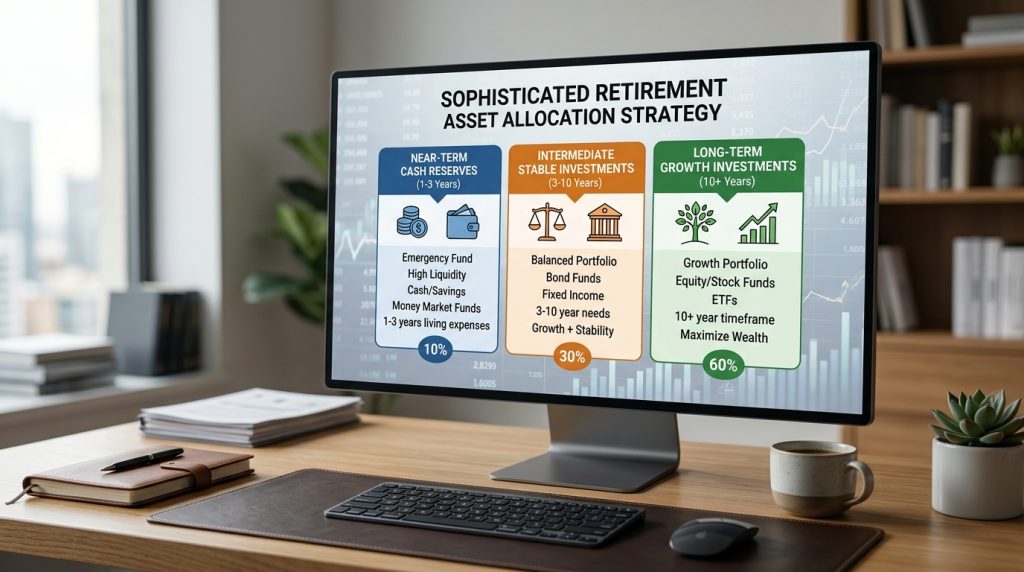
What Is a Retirement Income Bucket Strategy?
One way of organizing retirement assets is to divide them conceptually according to when the money may be needed.
The precise structure varies, but a simple framework may include three categories.
Near-Term Income Reserve
Money needed soon may be held in relatively liquid and lower-volatility assets.
Its purpose may include:
- Monthly spending
- Emergency expenses
- Taxes
- Near-term purchases
Intermediate-Term Assets
Assets intended for spending several years into retirement may seek a balance between stability and return.
Long-Term Growth Assets
Money that may not be needed for many years can potentially accept more short-term volatility in pursuit of long-term growth.
This approach can make the purpose of each investment easier to understand.
It does not guarantee that losses will be avoided, and it should not be implemented mechanically without considering taxes, market conditions, and individual circumstances.
What Is Sequence-of-Returns Risk?
Sequence risk refers to the impact of experiencing poor investment returns early in retirement while simultaneously withdrawing money.
Imagine two retirees who achieve the same average return over 20 years.
One experiences strong returns early and weak returns later.
The other experiences large losses immediately after retirement.
The second retiree may experience greater financial stress because withdrawals during an early downturn can force the sale of more shares when asset values are depressed.
Those shares are no longer available to participate fully in a later recovery.
How Can Sequence Risk Be Managed?
Possible techniques include:
- Maintaining adequate cash reserves
- Holding appropriately diversified investments
- Reducing discretionary withdrawals during severe downturns
- Using reliable income sources for essential expenses
- Rebalancing
- Avoiding excessive initial withdrawal rates
- Planning major purchases separately
No strategy can eliminate market risk.
The objective is to reduce the chance that a short-term market decline forces damaging long-term decisions.
How Much Cash Should a Retiree Keep?
There is no universal cash percentage.
The appropriate reserve depends on:
- Monthly expenses
- Social Security
- Pension income
- Portfolio size
- Market exposure
- Planned purchases
- Health
- Risk tolerance
Too little liquidity may force investments to be sold during unfavorable markets.
Too much cash held for many years may weaken long-term purchasing power.
The reserve should therefore have a defined purpose.
How Should the Investment Portfolio Be Structured?
Asset allocation should reflect the retiree’s:
- Spending needs
- Time horizon
- Reliable income
- Liquidity
- Risk tolerance
- Risk capacity
- Family goals
DATCU Wealth Management’s current asset-management service says portfolios are built around client objectives and risk tolerance and emphasizes diversification, asset allocation, income needs, and adjustment as goals evolve.
A retirement portfolio may use a combination of:
- Equities
- Bonds
- Cash
- Other investments appropriate to the individual plan
The exact combination should reflect the complete financial picture.
Why Is Diversification Important?
Diversification reduces dependence on one company, industry, security, or market outcome.
A retiree may diversify across:
- Asset classes
- Industries
- Companies
- Bond issuers
- Maturities
- Geographic regions
Diversification cannot prevent all losses.
Its purpose is to avoid making the retirement strategy overly dependent on a narrow group of investments.
Why Can Concentrated Stock Be Dangerous Near Retirement?
Employees and business owners sometimes enter retirement with a significant percentage of wealth tied to:
- Employer stock
- A former business
- One industry
- One property
Concentration may have contributed to wealth accumulation, but it can also expose retirement income to one financial outcome.
The planning process should evaluate:
- Tax basis
- Capital gains
- Income generated
- Diversification
- Emotional attachment
- Liquidity
- Retirement spending needs
Reducing concentration may need to occur gradually when taxes are significant.
What Is a Sustainable Withdrawal Strategy?
A sustainable withdrawal strategy attempts to provide enough retirement income without exhausting assets prematurely.
There is no withdrawal percentage that works for every retiree.
The appropriate amount depends on:
- Retirement age
- Portfolio allocation
- Market conditions
- Guaranteed income
- Longevity
- Inflation
- Fees
- Taxes
- Spending flexibility
- Legacy goals
A withdrawal plan should therefore be monitored rather than fixed permanently on the retirement date.
DATCU Wealth Management’s current site specifically includes withdrawal rates and withdrawal sequencing among the retirement strategies it addresses.
What Is Withdrawal Sequencing?
Withdrawal sequencing determines which financial resources are used and when.
Accounts may include:
- Cash
- Taxable brokerage accounts
- Traditional IRAs
- Roth IRAs
- Employer retirement plans
- Health savings accounts
The traditional assumption of spending one account completely before touching another may not always produce the most effective result.
Different accounts have different:
- Tax treatments
- Distribution requirements
- Growth characteristics
- Estate implications
A coordinated withdrawal strategy can evaluate the household over several years.
Why Should Retirement Income Be Planned After Taxes?
A retiree lives on net spendable income.
A $10,000 retirement distribution does not necessarily produce $10,000 available for spending.
Traditional retirement-account distributions may generally create taxable income. Taxable investment withdrawals may contain principal, dividends, interest, and gains. Roth distributions may receive different tax treatment when applicable requirements are satisfied.
Therefore, retirement planning should estimate both:
Gross income
and
After-tax income available for spending.
Why Is Multi-Year Tax Planning Useful?
Taxable income can vary significantly throughout retirement.
A retiree may experience:
- Final high-income working years
- Early retirement before Social Security
- Social Security commencement
- Pension commencement
- Required retirement-account distributions
- Death of a spouse and a change in filing status
The tax strategy that is appropriate during one period may not be appropriate during another.
Planning across several years may identify opportunities involving:
- Withdrawal timing
- Roth conversions
- Capital gains
- Charitable giving
- Retirement contributions
- Tax withholding
Specific tax recommendations should be reviewed with qualified tax professionals.
How Do Required Minimum Distributions Affect Income Planning?
Traditional retirement accounts may eventually require distributions under federal law.
That matters because a retiree may have accumulated substantial tax-deferred savings but not necessarily need all future mandatory withdrawals for current spending.
Required distributions can affect:
- Taxable income
- Cash flow
- Investment allocation
- Charitable planning
- Estate planning
DATCU Wealth Management’s live homepage specifically identifies required minimum distribution management as part of its retirement-planning work.
The exact RMD rules depend on age, account type, beneficiary status, and other factors, so current IRS guidance should be checked before implementation.
Why Should Healthcare Be Included in the Retirement Budget?
Healthcare does not disappear at retirement.
Potential expenses may include:
- Medicare premiums
- Supplemental coverage
- Prescription drugs
- Dental care
- Vision care
- Hearing care
- Deductibles
- Copayments
- Services not covered by insurance
Healthcare should therefore be included as its own retirement spending category rather than hidden within a general household budget.
DATCU Wealth Management’s retirement planning service includes Medicare planning alongside retirement income, Social Security, and long-term care.
How Is Long-Term Care Different From Regular Healthcare?
Long-term care generally relates to ongoing assistance with personal or daily living needs rather than treatment of a short-term medical condition.
Possible care settings may include:
- Home
- Assisted living
- Adult day services
- Nursing facilities
Medicare states that it generally does not pay for long-term custodial care when that is the only care a person needs.
Because extended care can create significant financial and family consequences, it should be considered before a crisis occurs.

What Does Long-Term Care Planning Involve?
Long-term care planning is broader than simply purchasing insurance.
The process may consider:
- Family health history
- Existing assets
- Retirement income
- Insurance
- Home equity
- Family support
- Desired care setting
- Estate goals
- Available coverage
- Ability to self-fund
DATCU Wealth Management’s current retirement-planning page identifies long-term care planning as part of its retirement process and describes evaluating coverage in relation to asset protection and potential family burden.
Possible strategies may involve:
- Dedicated savings
- Long-term care insurance
- Hybrid insurance approaches
- Self-funding
- A combination of resources
No one method is appropriate for every household.
Why Can Long-Term Care Affect the Entire Family?
A care event can create more than a financial expense.
Family members may need to provide:
- Transportation
- Personal assistance
- Financial management
- Household support
- Time away from employment
A retirement strategy should therefore ask both:
How might care be funded?
and:
Who would be responsible for coordinating it?
Advance planning can give the family more options.
How Does Inflation Affect Healthcare and Care Planning?
Some retirement expenses may increase faster than the household expects.
A retirement strategy that covers current healthcare costs but does not allow for future increases may underestimate later-life spending.
Long-term growth remains relevant even when the retiree already has adequate near-term income.
Money intended for expenses decades from now may need to preserve purchasing power until it is required.
How Should Major Purchases Be Planned?
A retirement plan can be disrupted by expenses that were predictable but never included in the projection.
Examples include:
- Vehicle replacement
- Roof replacement
- Major home renovation
- Family wedding
- Large vacation
- Second home
- Assistance to children
If a retiree expects a $75,000 purchase in two years, that money may not belong in the same investment strategy as assets intended for use 20 years later.
Major purchases should have:
- Estimated amount
- Expected timing
- Funding source
- Tax considerations
How Should Family Gifts Be Treated?
Retirees sometimes want to help:
- Children
- Grandchildren
- Aging parents
- Charities
Generosity should be coordinated with the retiree’s own long-term financial independence.
Before making a substantial gift, the plan should consider:
- Retirement spending
- Healthcare
- Long-term care
- Longevity
- Emergency reserves
- Taxes
- Investment risk
A gift that appears affordable today may have different implications when tested over several decades.
How Should a Surviving Spouse Be Included?
A retirement plan should not assume both spouses remain alive throughout retirement.
After the first death, the survivor may experience:
- Lower Social Security income
- Reduced pension income
- Changes in taxes
- Continued housing expenses
- Healthcare costs
- Investment-management responsibilities
The planning process should calculate income under at least two scenarios:
- Both spouses living
- One spouse surviving
This can reveal potential income gaps before they occur.
What Role Does Life Insurance Have in Retirement?
Life insurance needs may decline when:
- Children become independent
- Debt decreases
- Retirement assets grow
But coverage may still serve purposes such as:
- Supporting a surviving spouse
- Estate liquidity
- Business succession
- Family inheritance goals
Policies should be reviewed according to current objectives rather than automatically retained or cancelled.
How Often Should a Retirement Income Plan Be Reviewed?
Retirement planning should be ongoing.
DATCU Wealth Management states that its process includes formal annual review and continued adjustments as goals and circumstances change.
A review may also be appropriate after:
- Retirement
- Death of a spouse
- Significant market movement
- Major health diagnosis
- Inheritance
- Property sale
- Major purchase
- Change in tax law
- Change in Social Security plans
- Change in care needs
What Should an Annual Retirement Review Include?
Update Spending
Compare projected expenses with actual expenses.
Update Income
Review:
- Social Security
- Pension
- Investment income
- Employment
- Retirement distributions
Review the Portfolio
Evaluate:
- Allocation
- Risk
- Diversification
- Liquidity
- Rebalancing needs
Review Withdrawals
Determine whether the withdrawal rate remains appropriate.
Update Tax Projections
Estimate current-year taxable income and potential future changes.
Review Healthcare
Confirm Medicare, insurance, and expected out-of-pocket expenses.
Review Long-Term Care
Consider whether resources and plans remain appropriate.
Review Beneficiaries
Confirm retirement accounts, insurance, and estate documents remain aligned.
A Practical Retirement Income Framework
Step 1: Calculate Annual Spending
Separate:
- Essential spending
- Flexible spending
- Irregular expenses
Step 2: Identify Reliable Income
List:
- Social Security
- Pensions
- Other predictable income
Step 3: Calculate the Income Gap
Subtract dependable income from expected spending.
The remaining amount generally needs to be funded from investments and other assets.
Step 4: Build Near-Term Liquidity
Maintain enough accessible resources to reduce dependence on selling volatile investments at an unfavorable time.
Step 5: Invest for Longer-Term Needs
Use an appropriate diversified portfolio for money not expected to be spent immediately.
Step 6: Coordinate Social Security
Evaluate claiming age in relation to:
- Cash flow
- Longevity
- Spouse
- Survivor needs
- Investments
Step 7: Establish a Withdrawal Strategy
Determine how withdrawals may come from:
- Taxable investments
- Traditional retirement accounts
- Roth accounts
- Other assets
Step 8: Estimate Taxes
Convert gross retirement income into expected spendable income.
Step 9: Plan for Healthcare and Long-Term Care
Model both normal healthcare spending and larger care scenarios.
Step 10: Review Annually
Adjust for:
- Markets
- Inflation
- Spending
- Taxes
- Health
- Family changes
Common Retirement Income Planning Mistakes
Focusing Only on the Account Balance
A portfolio value does not explain how much sustainable after-tax income it can support.
Becoming Too Conservative Immediately
Excessive conservatism can weaken long-term growth and inflation protection.
Taking Too Much Investment Risk
Money needed soon should not depend entirely on favorable stock-market performance.
Claiming Social Security Without Household Analysis
The decision affects lifetime income and potentially the surviving spouse.
Ignoring Taxes
Gross withdrawals and spendable retirement income are different.
Ignoring Healthcare
Healthcare deserves a separate budget.
Ignoring Long-Term Care
A severe care event can affect both assets and family members.
Treating the Withdrawal Rate as Permanent
Spending, markets, and family circumstances change.
Failing to Plan Major Purchases
Large predictable expenses should have dedicated funding strategies.
Never Updating the Plan
A strategy developed at retirement may become outdated five or ten years later.
Frequently Asked Questions
How should retirement income be divided between stable income and investments?
There is no universal percentage. The appropriate balance depends on essential spending, Social Security, pensions, portfolio size, time horizon, risk tolerance, taxes, and expected longevity. Many retirees benefit from maintaining reliable resources for near-term needs while preserving diversified growth assets for longer-term spending.
Should retirees stop investing in stocks?
Not automatically. A retirement lasting several decades may still require long-term growth to help address inflation and longevity. The appropriate stock exposure depends on spending needs, reliable income, liquidity, risk tolerance, and financial capacity to withstand market losses.
What age can Social Security retirement benefits begin?
Eligible workers can generally begin Social Security retirement benefits as early as age 62. For people attaining age 62 in 2026, full retirement age is 67. Delaying benefits beyond full retirement age can increase the monthly amount until age 70.
Why does Social Security claiming age matter?
Starting benefits earlier generally produces a lower monthly amount, while delaying can increase monthly lifetime income. The decision can also affect portfolio withdrawals and survivor planning, so it should be evaluated within the entire household retirement strategy.
How does inflation affect a retirement income plan?
Inflation gradually increases the cost of goods and services. If retirement income does not grow over time, purchasing power may decline. This is why a long-term retirement strategy may need both near-term stability and investments capable of providing growth.
Is long-term care planning only about buying insurance?
No. Long-term care planning can include insurance, dedicated assets, family support, housing, desired care settings, estate objectives, and the household’s capacity to self-fund expenses. The appropriate approach depends on the individual’s financial and health circumstances.
Final Thoughts
A successful retirement income strategy is not built around a single investment, withdrawal percentage, or Social Security age.
It requires coordination.
Retirees need enough stability to pay current expenses without depending on favorable market conditions. They also need enough long-term growth to address inflation and the possibility of a lengthy retirement.
Social Security, pensions, investments, taxes, healthcare, liquidity, and long-term care should therefore be evaluated as parts of one system.
DATCU Wealth Management’s current retirement-planning approach follows this broad framework, emphasizing reliable income, long-term growth, inflation awareness, Social Security strategy, long-term care, Medicare considerations, and a retirement plan designed to evolve as the client’s life changes.
The objective is not to predict precisely what markets, inflation, taxes, or healthcare costs will do. It is to create a retirement-income structure flexible enough to respond when conditions differ from expectations.
This article is intended for general educational purposes only. It does not provide individualized investment, tax, accounting, legal, Social Security, Medicare, insurance, long-term-care, or retirement advice. Readers should consult appropriately qualified professionals regarding their circumstances.
