


The best scrubs for nurses provide unrestricted movement, breathable comfort, dependable pocket storage, and a secure fit that remains consistent throughout the shift. Nurses should evaluate fabric weight, stretch recovery, shoulder mobility, waistband construction, inseam length, and pocket placement rather than choosing scrubs based only on appearance or brand recognition.
The right scrub set should support the nurse’s work routine without requiring frequent pulling, tightening, or readjustment.
Quick Answer
Nurses should look for scrubs that include:
- Lightweight or breathable fabric suited to the work environment
- Enough stretch for bending, reaching, and repeated movement
- A secure waistband that remains comfortable while sitting and standing
- Functional pockets positioned for the items carried most often
- Correct shoulder, hip, rise, and inseam measurements
- Durable construction for frequent washing
- A professional fit that is neither restrictive nor excessively loose
No single scrub style is best for every nurse. The right choice depends on the clinical setting, shift length, dress code, body proportions, temperature, and storage needs.
Why does choosing the right nursing scrubs matter?
Nurses work in hospitals, physicians’ offices, home healthcare, nursing facilities, outpatient clinics, schools, and other settings. These environments can involve very different movement patterns, temperatures, schedules, and uniform requirements. The U.S. Bureau of Labor Statistics also notes that registered nurses may spend substantial time walking, bending, stretching, and standing.
Scrubs are therefore not simply workplace clothing. They are garments worn during repeated movement, long periods of standing, seated documentation, patient interaction, and transitions between different areas of a facility.
Poorly fitted scrubs can create several avoidable distractions:
- A waistband that rolls or slips
- Sleeves that restrict reaching
- Pants that drag at the heel
- Fabric that feels heavy in warm environments
- Pockets that pull the garment out of shape
- Necklines that shift while bending
- Seams that rub during repeated movement
Comfortable scrubs cannot reduce the broader workload of nursing or replace proper staffing, rest, safe handling practices, and workplace safety programs. However, well-selected workwear can eliminate some unnecessary sources of physical distraction.
What makes scrubs comfortable for nurses?
Comfort is the result of several features working together.
A fabric may feel soft but become warm after several hours. A waistband may feel secure while standing but create pressure when sitting. A top may look fitted but pull across the upper back when the arms move forward.
Nurses searching for comfortable medical scrubs should evaluate the full garment rather than relying on one feature such as softness or stretch.
The main comfort factors are:
- Fabric weight
- Breathability
- Stretch and recovery
- Garment cut
- Seam placement
- Waistband pressure
- Inseam length
- Pocket weight distribution
Comfort should be tested through movement
Scrubs should be evaluated in positions that reflect actual work.
A basic test should include:
- Sitting fully in a chair
- Reaching forward with both arms
- Reaching overhead
- Bending carefully
- Squatting or lowering toward the floor
- Walking quickly
- Raising one knee
- Placing lightweight items in the pockets
The garment should remain secure without pulling strongly across the shoulders, waist, hips, thighs, or knees.
Which scrub fabrics are best for nurses?
There is no universal best fabric blend. The ideal material depends on work environment, personal preference, washing routine, and desired structure.
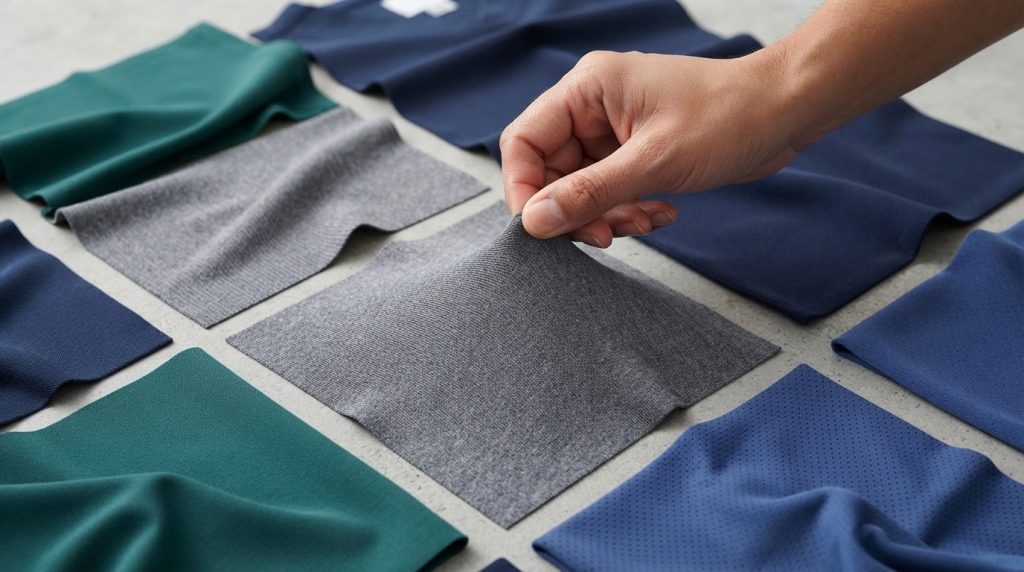
Polyester blends
Polyester is commonly used in scrub fabrics because it can contribute to shape retention, wrinkle resistance, and relatively easy care.
A polyester-rich blend may suit nurses who prioritize:
- Consistent shape
- Reduced wrinkling
- Quick drying
- Frequent laundering
- Smooth fabric texture
However, fabric performance varies by construction. Two garments with similar fiber percentages may feel very different because of weave, weight, finishing, and added stretch.
Cotton blends
Cotton can contribute softness and a familiar fabric feel.
Cotton-blend scrubs may appeal to nurses who prefer:
- A softer hand feel
- Less slick fabric
- A more traditional textile texture
- A structured but comfortable appearance
Higher cotton content may also affect drying time, shrinkage behavior, and wrinkle resistance. The care label should always be reviewed before purchase.
Rayon or viscose blends
Rayon-type fibers can add softness, drape, and flexibility.
These fabrics may feel comfortable against the skin, but nurses should also assess:
- Whether the garment holds its shape
- How it performs after washing
- Whether it feels too clingy
- Whether it suits the workplace dress code
Spandex or elastane
A small percentage of stretch fiber can improve flexibility and help the garment move with the body.
More stretch is not automatically better. Scrubs should return to their original shape after movement rather than sagging at the knees, elbows, seat, or pockets.
How much stretch do nursing scrubs need?
Nursing work frequently involves forward reaching, repositioning, bending, walking, and changes in posture. OSHA identifies repeated patient handling, repositioning, lifting, and awkward postures as significant sources of physical strain in healthcare settings. OSHA also emphasizes that appropriate equipment and safe-patient-handling systems are necessary for managing these risks.
Stretch fabric does not make unsafe lifting safe. Its role is much narrower: allowing workwear to move comfortably during normal tasks.
A practical scrub fabric should stretch enough to support:
- Reaching toward equipment
- Bending during routine tasks
- Sitting for documentation
- Walking quickly
- Moving between patient areas
- Raising the arms without lifting the entire top
How to test stretch recovery
Gently extend the fabric and release it.
Then check whether it:
- Returns to its original shape
- Remains visibly stretched
- Feels thin when extended
- Becomes transparent under tension
- Creates rippling or bagging
Stretch recovery often matters as much as stretch itself. A highly flexible fabric that loses shape may become less comfortable as the shift continues.
How should a nursing scrub top fit?
A nursing scrub top should provide enough room through the shoulders, chest, back, and arms while maintaining appropriate coverage.
Shoulder fit
The shoulders are one of the most important areas to test.
Reach both arms forward as if accessing equipment or assisting with a routine task. The top should not create strong pulling across the upper back.
Then raise the arms overhead. Watch whether:
- The entire top rises excessively
- The neckline shifts
- The armholes become tight
- The hem exposes too much coverage
- The sleeves restrict movement
The goal is functional room, not simply a larger size.
Chest and torso fit
The scrub top should fall smoothly without excessive strain across the chest or large amounts of loose fabric around the torso.
A top that is too tight may:
- Pull at the side seams
- Create gaps near the neckline
- Restrict reaching
- Ride upward during movement
A top that is too loose may:
- Shift while bending
- Catch on nearby objects
- Hide pocket openings
- Create excess bulk under jackets
Top length
Scrub top length affects coverage and pocket access.
A short top may rise while reaching. A very long top may overlap pant pockets or bunch around the hips when sitting.
Side vents can improve movement, especially when the top extends below the hip.
Neckline coverage
V-neck, round-neck, mock-wrap, notched, and zip-neck scrub tops behave differently during movement.
Coverage should be checked while:
- Leaning forward
- Sitting
- Reaching downward
- Wearing normal work underlayers
A neckline that looks appropriate while standing may shift when the body bends.
Which pockets are most useful on scrub tops?
Pocket quantity should match the nurse’s actual routine.
Nurses comparing scrub tops with pockets should consider placement and accessibility, not just the total pocket count.
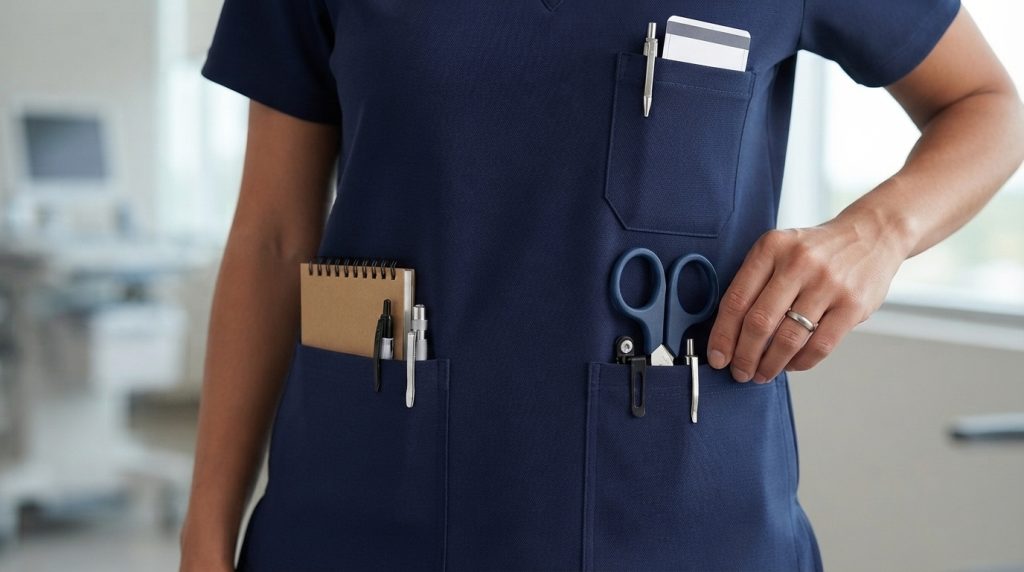
Chest pockets
Chest pockets offer quick access to lightweight items such as pens or a small note card.
They are less suitable for heavier objects because added weight can pull the neckline or front of the top downward.
Lower patch pockets
Lower patch pockets provide larger storage areas and can distribute weight more evenly across the front of the garment.
They may be useful for:
- Pens
- Small notebook
- Penlight
- Approved utility scissors
- Lightweight communication accessories
Hidden or interior pockets
Interior compartments help separate smaller objects and reduce pocket clutter.
They can make it easier to keep a frequently used item in a consistent position.
Zippered pockets
A zippered pocket may help secure a key, card, or small personal item.
The zipper should not press uncomfortably against the body when sitting or bending.
Pocket placement matters more than pocket count
A seven-pocket top is not automatically more practical than a three-pocket design.
Consider:
- Which hand normally reaches for the item
- Whether the pocket is accessible under a jacket
- Whether objects fall out while sitting
- Whether a loaded pocket pulls the top downward
- Whether items interfere with bending
The most effective pocket configuration is the one that keeps necessary items accessible without overloading the garment.
How should scrub pants fit nurses?
Scrub pants must fit correctly at the waist, hips, thighs, rise, knees, and inseam.
A poor fit in one area can affect the entire garment.
Nurses considering comfortable scrub pants should test them while both standing and sitting.
Which scrub pant waistband is most comfortable?
Common waistband options include:
- Full elastic
- Drawstring
- Yoga-style knit waistband
- Elastic with drawstring
- Partial knit panels
- Rib-knit waistband
- Flat-front waistband with elastic sections
Full elastic waistbands
Full elastic can provide simple, consistent support.
The elastic should feel secure without digging into the waist or folding while sitting.
Drawstring waistbands
Drawstrings allow the wearer to adjust the waist manually.
They can be helpful when body proportions fall between standard sizes, but the knot should not create pressure under a scrub top.
Yoga-style waistbands
Wide knit waistbands distribute pressure across a larger area and may feel softer during long periods of sitting or movement.
The waistband should still recover properly and remain in place rather than rolling downward.
Hybrid waistbands
Elastic and drawstring combinations provide both stretch and adjustability.
This design may work well for nurses whose pockets frequently carry additional weight.
What is the best scrub pant rise?
Rise describes how the pants sit between the waistband and crotch.
Common options include:
- Low rise
- Mid rise
- Natural rise
- High rise
Mid-rise pants work for many wearers, but the correct rise depends on torso length, hip shape, and personal preference.
A rise that is too short may:
- Pull while sitting
- Create pressure through the crotch
- Slide downward during bending
A rise that is too long may:
- Bunch below the waistband
- Create excess fabric
- Shift while walking
Nurses should not assume the same rise will fit identically across different scrub collections.
Which scrub pant style is best for nurses?
Jogger scrub pants
Joggers taper toward the ankle and usually include a cuff.
They may be suitable for nurses who prefer:
- Reduced fabric around the lower leg
- A modern silhouette
- Secure ankle coverage
- Easy pairing with athletic-style work shoes
The cuff should not feel excessively tight or ride upward during sitting.
Tapered scrub pants
Tapered pants narrow gradually toward the ankle without necessarily using an elastic cuff.
They provide a streamlined appearance while retaining a more traditional hem.
Straight-leg scrub pants
Straight-leg pants maintain a relatively consistent shape from the thigh downward.
They can provide a classic professional appearance and may feel less restrictive around the calf.
Cargo scrub pants
Cargo scrub pants add storage along the thigh.
They are useful when additional pocket space is needed, but large or heavy items may swing against the leg while walking.
Flare or bootcut scrub pants
Flare and bootcut styles widen below the knee.
They may suit nurses who prefer more room around the lower leg, but the hem must be checked carefully to prevent dragging.
Why is inseam length important?
An incorrect inseam can affect safety, appearance, and comfort.
Pants that are too long may drag under footwear or collect dirt near the floor. Pants that are too short may rise significantly while sitting.
Typical length categories include:
- Petite
- Short
- Regular
- Tall
These labels are not standardized across every manufacturer.
The best approach is to measure the inseam of a well-fitting pair of work pants and compare it with the garment’s specific size chart.
Work shoes should also be considered during fitting because sole height can change how the hem falls.
Are breathable scrubs better for nurses?
Breathable or lightweight scrubs can be helpful in warm environments, active departments, or situations where additional layers are worn.
However, breathability should be evaluated together with:
- Fabric coverage
- Durability
- Stretch
- Opacity
- Workplace dress requirements
- Temperature fluctuations
A very lightweight fabric may feel comfortable during movement but less suitable in a cool facility. Some nurses solve this by combining a lightweight base scrub set with a removable scrub jacket.
The ideal fabric should remain comfortable across the nurse’s most common work conditions.
Should nurses choose fitted or relaxed scrubs?
Neither option is automatically better.
Fitted scrubs
Fitted styles follow the body more closely and may provide a modern appearance.
They should still allow:
- Full shoulder movement
- Comfortable sitting
- Hip and thigh mobility
- Appropriate neckline coverage
Relaxed scrubs
Relaxed styles provide more room through the torso, hips, or legs.
They should not be so oversized that they shift, bunch, or create excess fabric around work areas.
The best fit is functional
The correct fit sits between restrictive and excessively loose.
Scrubs should follow workplace dress standards while allowing the nurse to perform routine movements without repeated adjustment.
How should work setting influence scrub choice?
Registered nurses work across many environments, and the Bureau of Labor Statistics notes that work schedules and physical demands can vary significantly by setting. Nurses in hospitals and nursing facilities may work shifts, nights, weekends, and holidays, while office- and school-based roles are more likely to follow regular business hours.
Hospital nursing
Hospital nurses may prioritize:
- Flexible fabric
- Secure pockets
- Easy-care construction
- Layering options
- Comfortable waistbands
- Reliable movement
Clinic and physician office nursing
Clinic-based nurses may place greater emphasis on:
- Professional tailoring
- Coordinated scrub sets
- Lighter pocket needs
- Consistent color presentation
Long-term care
Long-term care roles may involve repeated movement and patient assistance.
Mobility, waistband security, and practical pocket access may be particularly important.
Home healthcare
Home healthcare nurses may travel between locations and experience changing temperatures.
Wrinkle resistance, layering, secure storage, and all-day comfort may be priorities.
School nursing
School nurses may prefer professional but approachable styling, practical storage, and garments that remain comfortable through varied daily activities.
How can nurses test scrubs before buying?
A scrub set should be tested for at least several minutes before a final decision.
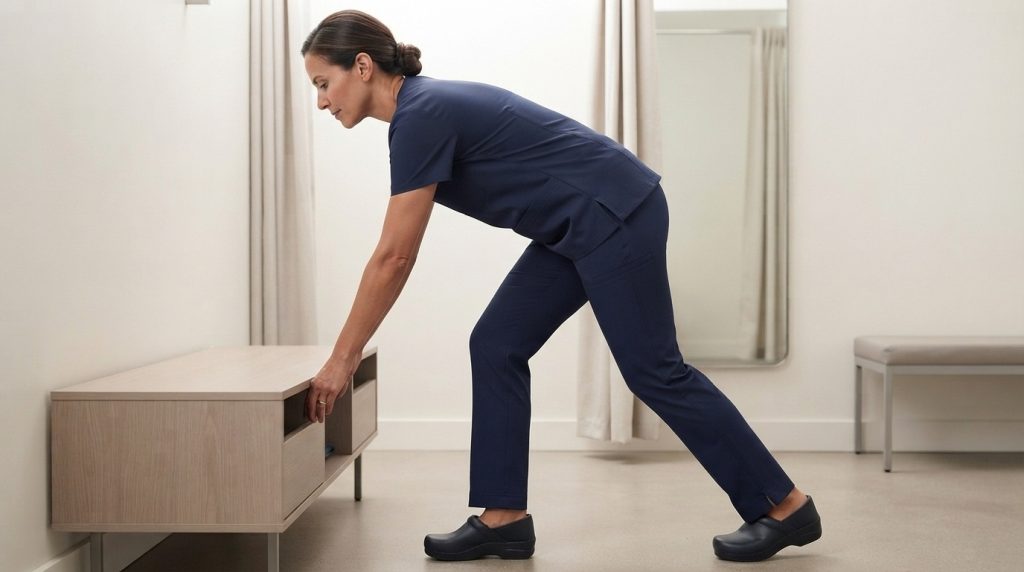
Five-minute nursing scrub test
- Wear normal work underlayers.
- Put on the shoes commonly worn at work.
- Sit fully in a chair.
- Stand and walk.
- Reach forward and overhead.
- Bend carefully at the knees and hips.
- Place lightweight objects in the pockets.
- Check the neckline while leaning forward.
- Confirm that the waistband remains secure.
- Inspect the pant hem and inseam.
For nurses who prefer to compare several cuts and fabrics in person, visiting a medical scrub store in Lincoln can make it easier to evaluate sizing, texture, pocket access, and inseam length before purchasing.
What common mistakes should nurses avoid?
Choosing by size label alone
Sizing varies among brands and collections. Always check the garment-specific chart.
Buying the same size in every style
A jogger, straight-leg pant, and fitted top may each require different sizing decisions.
Ignoring pocket weight
A garment may fit well when empty but shift when pockets are loaded.
Testing scrubs only while standing
Sitting, reaching, and bending reveal problems that are not visible in a mirror.
Choosing excessive stretch without checking recovery
Stretch should support movement without causing permanent sagging.
Ignoring workplace dress codes
Color, embroidery, neckline, fit, print, and layering requirements should be confirmed before purchase.
Buying an incorrect inseam
Pant length labels differ. Measurements are more reliable than assumptions.
How should nurses care for medical scrubs?
Always follow the garment care label and employer requirements.
General care considerations include:
- Empty all pockets before washing.
- Separate colors when recommended.
- Use the specified water temperature.
- Avoid excessive dryer heat when prohibited by the label.
- Close zippers when appropriate.
- Inspect seams and waistbands regularly.
- Replace garments that have become damaged, excessively faded, or poorly fitted.
Scrubs exposed to workplace contamination may be subject to facility-specific handling and laundering policies. Personal garment care should not override infection-control or employer procedures.
How many scrub sets should a nurse own?
There is no universal number.
The appropriate rotation depends on:
- Shifts worked per week
- Laundry frequency
- Workplace color requirements
- Whether uniforms are employer-issued
- Need for backup clothing
- Seasonal layering needs
A practical rotation provides enough clean sets for scheduled shifts plus at least one backup option when possible.
Once a nurse finds a dependable top, pant, and fabric combination, purchasing compatible pieces can simplify daily dressing and future replacement.
Final Thoughts
The best scrubs for nurses are not defined by one fabric, pocket count, or pant style.
A dependable scrub set should:
- Move naturally
- Remain secure
- Provide appropriate storage
- Match the work environment
- Maintain professional coverage
- Fit correctly at the shoulders, waist, hips, rise, and inseam
- Withstand the required care routine
Nurses should evaluate scrubs as professional workwear. The best choice is the garment that supports the wearer’s actual shift rather than the style that looks best while standing still.
Frequently Asked Questions
What type of scrubs is most comfortable for nurses?
The most comfortable scrubs generally combine lightweight fabric, useful stretch, a secure waistband, proper shoulder room, and the correct inseam. Comfort depends on body proportions and work setting, so nurses should test scrubs while sitting, reaching, bending, and walking.
Are expensive nursing scrubs always more comfortable?
No. Price may reflect fabric technology, construction, branding, or design details, but it does not guarantee a better fit. An affordable scrub set with the correct rise, inseam, and shoulder measurements may feel more comfortable than a costly set that does not suit the wearer.
How tight should nursing scrubs be?
Scrubs should follow the body without restricting movement. A top or pant is likely too tight if it pulls strongly while sitting, reaching, or bending. Scrubs may be too loose if they shift constantly, bunch under layers, or create excessive fabric around work areas.
Are jogger scrub pants good for nurses?
Joggers can work well for nurses who prefer a tapered leg and reduced fabric around the ankle. The waistband, thigh room, rise, cuff, and inseam must still fit correctly. Some nurses may find straight-leg or tapered pants more comfortable.
How many pockets do nurses need in their scrubs?
The ideal number depends on what the nurse carries. Pocket placement and accessibility are more important than the total count. Nurses should list their routine items and choose pockets that hold them without overloading or pulling the garment.
What fabric blend is best for nursing scrubs?
Polyester blends often provide shape retention and easy care, cotton blends may feel softer, rayon can improve drape, and elastane adds flexibility. The best blend depends on temperature, texture preference, movement needs, and laundry requirements.
