

A car accident can be stressful, confusing, and painful. In the first few minutes after a crash, it can be hard to think clearly. You may be worried about your vehicle, the other driver, your passengers, insurance, work, or whether you are injured.
The most important thing is to take the right steps in the right order: make sure everyone is safe, call for emergency help when needed, document the accident, and pay attention to your body in the hours and days that follow.
Many accident-related injuries do not appear immediately. You may feel okay at the scene, then notice neck pain, back pain, headaches, stiffness, soreness, or reduced mobility later that day or the next morning.
For patients looking for accident and injury Mesquite care after a crash, Premier Injury Clinics of DFW’s Mesquite location provides accident-focused evaluations, chiropractic care, rehabilitation therapy, and structured recovery support for auto accident injuries.

Quick Answer
After a car accident in Mesquite, first check for injuries, move to a safe location if possible, call 911 if anyone is hurt or the crash is serious, exchange information, document the scene, and report the accident as required. After the immediate situation is handled, monitor your body for symptoms such as neck pain, back pain, headaches, stiffness, soreness, tingling, numbness, or reduced mobility.
If you have severe symptoms such as chest pain, trouble breathing, loss of consciousness, repeated vomiting, confusion, weakness, severe headache, heavy bleeding, or numbness after the crash, seek emergency medical care immediately.
The U.S. Department of Transportation emphasizes post-crash care as an important part of improving crash survivability and helping injured people receive timely medical attention after serious collisions.
Key Takeaways
- Your first priority after a car accident is safety: check for injuries, call 911 when needed, and move away from traffic if it is safe to do so.
- Accident symptoms may appear hours or days later, especially neck pain, back pain, headaches, stiffness, soreness, and reduced mobility.
- Documenting the accident scene, vehicle damage, symptoms, and medical visits can help create a clear record after the crash.
- An injury evaluation may help identify hidden injuries, document symptoms, and guide a structured recovery plan.
- Premier Injury Clinics of DFW’s Mesquite location serves patients from Mesquite, Garland, Balch Springs, Forney, Sunnyvale, and surrounding areas.
Step 1: Check for Injuries and Call for Help
Immediately after a crash, check yourself and your passengers for injuries. If anyone is seriously hurt, call 911 right away. You should also call emergency services if the crash involves major vehicle damage, blocked traffic, a possible impaired driver, or unsafe road conditions.
Do not try to move someone who may have a serious neck, back, or head injury unless they are in immediate danger. Wait for emergency responders when the situation appears serious.
Seek emergency medical care immediately if you or someone else has:
- Loss of consciousness
- Chest pain
- Trouble breathing
- Severe headache
- Confusion
- Repeated vomiting
- Heavy bleeding
- Weakness on one side of the body
- Slurred speech
- Severe neck or back pain
- Numbness or weakness in the arms or legs
When in doubt, choose emergency care first.
Step 2: Move to a Safe Location, if Possible
If the vehicles are creating a hazard and can be moved safely, move them out of traffic. Turn on hazard lights and stay alert to surrounding vehicles.
Mesquite drivers may be involved in crashes on busy roads such as I-635, I-30, U.S. 80, Town East Boulevard, Gus Thomasson Road, and nearby local routes. Even after the initial crash, secondary accidents can happen if vehicles and people remain in traffic lanes.
If it is not safe to move your vehicle, stay as safe as possible and wait for emergency responders.
Step 3: Exchange Information
Once everyone is safe, exchange information with the other driver. Try to collect:
- Full name
- Phone number
- Driver’s license information
- Insurance company and policy number
- License plate number
- Vehicle make, model, and color
- Contact information for witnesses
- Police report number, if available
Avoid arguing about fault at the scene. Stay calm, collect the necessary information, and let the proper parties handle the investigation.
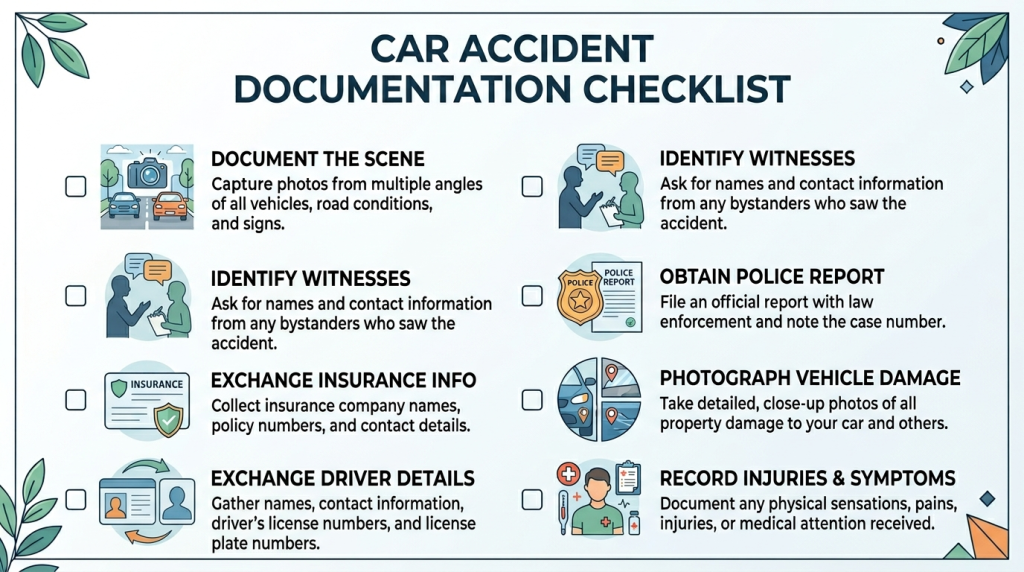
Step 4: Document the Accident Scene
If it is safe to do so, take photos and notes before leaving the scene. Good documentation can help you remember details later.
Consider documenting:
- Vehicle damage
- License plates
- Road conditions
- Traffic signs or signals
- Skid marks or debris
- Weather conditions
- Visible injuries
- Location of the crash
- Names and contact details of witnesses
- Symptoms you notice immediately after the accident
You should also write down what happened while the details are fresh. Include the time, location, direction of travel, and how the collision occurred.
Step 5: Watch for Delayed Symptoms
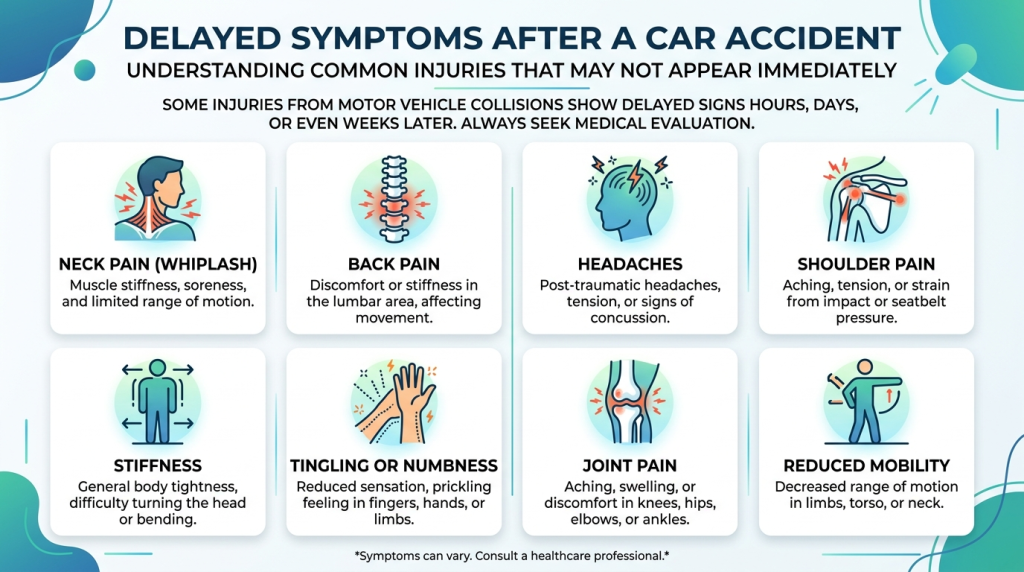
Not all injuries hurt immediately. After a crash, adrenaline and stress can temporarily reduce your awareness of pain. Inflammation may also build gradually in muscles, ligaments, joints, and soft tissues.
That is why many people feel worse the next day than they did at the scene of the accident.
Delayed symptoms after a car accident may include:
- Neck pain or stiffness
- Back pain
- Headaches
- Shoulder pain
- Muscle tightness
- Soreness
- Tingling or numbness
- Hip, knee, or joint pain
- Reduced range of motion
- Pain while sitting, standing, walking, or driving
- Trouble sleeping because of discomfort
Do not ignore symptoms that continue, worsen, or interfere with normal activities.
Step 6: Get Evaluated If Pain or Stiffness Develops
If you develop pain after a crash, an injury evaluation can help you understand what may be happening. This is especially important if symptoms affect your neck, back, head, shoulders, joints, or mobility.
At Premier Injury Clinics of DFW’s Mesquite location, accident-related care may include evaluation, chiropractic care, rehabilitation therapy, soft tissue support, documentation, and a structured recovery plan based on the patient’s symptoms and progress.
You should consider scheduling an evaluation if you notice:
- Neck pain after a rear-end collision
- Back pain after impact
- Headaches after the crash
- Pain that gets worse over time
- Tingling or numbness in the arms or legs
- Difficulty turning your head
- Pain while sitting, standing, walking, or driving
- Trouble sleeping because of pain
- Shoulder, hip, knee, or joint pain
- Stiffness that does not improve
Early evaluation may help identify hidden injuries and reduce confusion about your next step.
Common Injuries After a Car Accident
Car accidents can affect the spine, joints, muscles, ligaments, and soft tissues. Some injuries are obvious immediately, while others appear gradually.
Whiplash
Whiplash is commonly associated with rear-end collisions. It occurs when the neck moves rapidly forward and backward, placing stress on muscles, ligaments, joints, and soft tissues.
Mayo Clinic describes whiplash as a neck injury caused by forceful, rapid back-and-forth movement of the neck, often from rear-end auto accidents. Symptoms may include neck pain, stiffness, headaches, shoulder or upper back pain, reduced range of motion, tingling, tiredness, and dizziness.
Back Pain
Back pain may develop after impact, especially when the body twists, braces, or absorbs force suddenly. It may feel like soreness, tightness, sharp pain with movement, or discomfort while sitting, standing, bending, or walking.
Soft Tissue Injuries
Soft tissue injuries affect muscles, ligaments, and tendons. These injuries may cause soreness, swelling, bruising, stiffness, tenderness, and reduced mobility.
Headaches
Headaches after a crash may be related to neck strain, whiplash, muscle tension, concussion, or other injury patterns. A severe or worsening headache should be taken seriously, especially when combined with confusion, vomiting, dizziness, weakness, vision changes, or loss of consciousness.
Shoulder, Hip, Knee, and Joint Pain
During a collision, drivers and passengers may brace against the steering wheel, floorboard, door, dashboard, or seatbelt. This can contribute to pain in the shoulders, wrists, hips, knees, or other joints.

What to Expect During an Accident Injury Evaluation
An accident injury evaluation is designed to understand what happened during the crash and how your symptoms are affecting your daily life.
Your first visit may include:
- A discussion about the accident
- Review of symptoms
- Review of when the pain started
- Neck, back, and joint mobility assessment
- Range-of-motion evaluation
- Pain and tenderness review
- Functional movement assessment
- Treatment recommendations
- Recovery plan discussion
- Documentation of accident-related findings
The goal is to help identify injury patterns, document your condition, and recommend a recovery plan based on your needs.
Red Flags: When to Seek Emergency Care
Chiropractic and rehabilitation care may help many accident-related musculoskeletal injuries, but some symptoms require emergency medical attention.
The CDC explains that mild traumatic brain injury and concussion symptoms may appear right away or hours to days after an injury. The CDC also lists danger signs after a possible traumatic brain injury, including worsening headache, repeated vomiting, weakness, numbness, seizures, slurred speech, confusion, unusual behavior, unequal pupils, or loss of consciousness.
Seek emergency care immediately if you experience:
- Loss of consciousness
- Chest pain
- Trouble breathing
- Severe or worsening headache
- Confusion
- Repeated vomiting
- Weakness on one side of the body
- Slurred speech
- Heavy bleeding
- Severe abdominal pain
- Severe neck or back pain after trauma
- Numbness or weakness in the arms or legs
- Loss of bladder or bowel control
If any of these symptoms appear, do not wait for a routine appointment. Get emergency care first.
Why Local Mesquite Accident Injury Care Matters
After a car accident, nearby care can make recovery easier. Some injuries require more than one visit, and a local clinic can help patients stay consistent with treatment and follow-up care.
Premier Injury Clinics of DFW’s Mesquite location serves patients from:
- Mesquite
- Garland
- Balch Springs
- Forney
- Sunnyvale
- Nearby Dallas County and Kaufman County areas
- Surrounding communities
The Mesquite clinic is located at:
3501 Gus Thomasson Rd, Suite 75
Mesquite, TX 75150
For qualifying patients injured in an auto accident, transportation assistance may be available. This may be helpful if your vehicle was damaged or if driving is uncomfortable after the crash.
What Not to Do After a Car Accident
The steps you avoid can be just as important as the steps you take.
After a crash, try not to:
- Leave the scene before it is appropriate
- Ignore pain that appears later
- Assume minor vehicle damage means no injury
- Delay emergency care for serious symptoms
- Forgot to document the accident
- Skip follow-up if symptoms continue
- Push through neck pain, back pain, or headaches
- Return too quickly to heavy activity if pain worsens
Taking symptoms seriously can help protect your health and support a clearer recovery process.
Frequently Asked Questions
Should I see a doctor after a minor car accident?
You should seek emergency care for serious symptoms. If the crash seems minor but you develop neck pain, back pain, headaches, stiffness, soreness, numbness, tingling, or reduced movement, consider scheduling an injury evaluation.
What if I felt fine right after the accident?
Feeling fine immediately after a crash does not always mean you are uninjured. Adrenaline may mask pain, and inflammation can build over time. Monitor your body closely for delayed symptoms.
How soon can symptoms appear after a car accident?
Some symptoms appear immediately, while others may develop hours or days later. Neck pain, back pain, headaches, stiffness, and soreness are common delayed symptoms.
What should I bring to an accident injury appointment?
Bring your photo ID, insurance information if applicable, accident details, claim information if available, a list of symptoms, and any urgent care or hospital records related to the crash.
Can whiplash happen in a low-speed accident?
Yes. Whiplash can occur when the neck moves suddenly during impact. Symptoms may include neck pain, stiffness, headaches, shoulder discomfort, and reduced range of motion.
Does Premier Injury Clinics of DFW serve areas near Mesquite?
Yes. The Mesquite location serves patients from Mesquite, Garland, Balch Springs, Forney, Sunnyvale, and surrounding areas.
Is transportation available after an auto accident?
Transportation assistance may be available for qualifying patients injured in an auto accident. Contact the Mesquite location to learn more about availability and eligibility.
Final Thoughts
After a car accident in Mesquite, the most important steps are to stay safe, call for emergency help when needed, document the crash, monitor your symptoms, and get evaluated if pain or stiffness develops.
Delayed symptoms are common after auto accidents. Neck pain, back pain, headaches, soreness, stiffness, and reduced mobility may appear hours or days after the collision.
Premier Injury Clinics of DFW provides accident-focused chiropractic care, rehabilitation therapy, and structured recovery support for patients recovering after auto accidents in Mesquite and nearby communities.
Visit the Premier Injury Clinics of DFW Mesquite location page to learn more about accident injury evaluations, treatment options, transportation assistance for qualifying patients, and recovery care after a car accident.
